Statement by Ambassador Amar Bendjama at the Security Council following the vote on a resolution concerning Western Sahara.
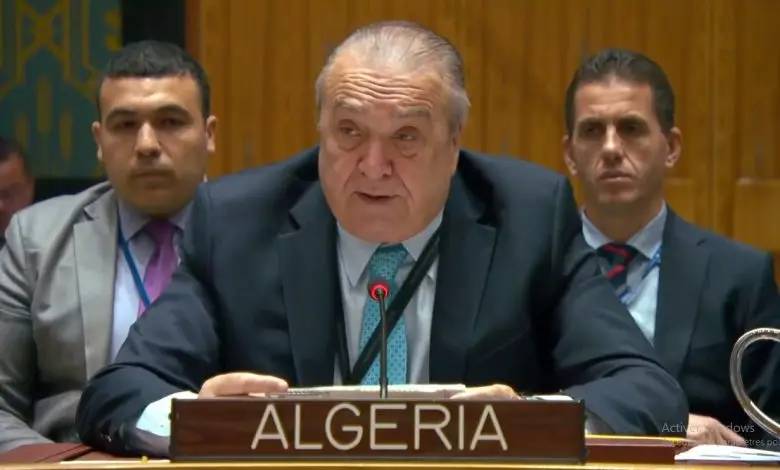
The full statement delivered by His Excellency Ambassador Amar Bendjama, Permanent Representative of Algeria to the United Nations, during the UN Security Council meeting on October 31, 2025, following the vote on the draft resolution concerning the situation in Western Sahara.
"Mr. President,
• My country did not participate in the vote on this draft resolution renewing the mandate of the United Nations Mission for the Referendum in Western Sahara.
• By this absence, and in all responsibility, Algeria wished to illustrate its distancing from a text that does not faithfully reflect the UN doctrine on decolonization.
Yes, we are speaking of decolonization.
It is the implementation of this doctrine that has allowed many nations to be represented here among us, at the United Nations. Must this obvious fact be recalled? The final decision on their future must belong only to the peoples still under colonial domination.
• In this regard, allow me to quote President Woodrow Wilson, who affirmed, "Peoples are not to be handed about from one sovereignty to another by an international conference or an understanding between rivals and antagonists. National aspirations must be respected; peoples may now be dominated and governed only by their own consent. 'Self-determination' is not a mere phrase. It is an imperative principle of action." End quote.
I invite you all to reflect deeply on this declaration.
Mr. President,
• As a neighboring country to the protagonists in Western Sahara, Algeria engaged in good faith, and with a constructive spirit, in the negotiation of the text proposed to us.
• And, I wish to take this opportunity to thank the penholder, the United States, which, contrary to what happened last year, spared no effort to improve the text and reach a compromise among the stakeholders. A compromise that could have united all members of the Council.
Of course, and we openly acknowledge, substantial improvements were made to the initial text.
• First, by recalling the fundamental parameters of a just and durable solution to the Western Sahara conflict;
• Next, by enshrining the inalienable right of the people of Western Sahara to self-determination;
• Finally, by committing the two Parties, the Kingdom of Morocco and the Polisario Front, to negotiations in good faith and without preconditions, under the auspices of the United Nations.
• But, unfortunately, the text ultimately submitted to us still suffers from shortcomings.
• It falls short of the expectations and legitimate aspirations of the People of Western Sahara, represented by the Polisario Front. This People who, for more than 50 years, has resisted to have and, alone, its say in its own destiny.
• So, what is missing from this text?
• If the unanimously shared objective is to find a durable, just, and mutually acceptable solution that provides for the right to self-determination of the People of Western Sahara, the means to achieve it raises, I must emphasize, legitimate questions.
• In our view, the narrow framework of the proposed negotiation, which prioritizes one option over others, prevents the necessary creativity and flexibility from being deployed to reach a freely consented agreement in application of the UN doctrine on decolonization.
• Furthermore, this text creates an imbalance between the two conflicting parties by focusing only on the territorial ambition of one and passing over in silence the aspirations of the other, in this case the Sahrawi people who demand freedom.
• As proof, this text ignores the proposals of the POLISARIO Front, even though they were transmitted just recently to the Secretary-General of the United Nations and the Security Council and published under the reference (S/2025/664).
• It is a party to the conflict and its opinion must be heard, if not taken into consideration.
This text, finally, raises serious and legitimate questions about the legal foundations of this proposed negotiation framework for the settlement of the Western Sahara conflict. Imagine if this framework were to be reproduced in other conflict zones, in Europe, the Americas, Asia, and Africa. It is then one of the main pillars of the very edifice of the international order that will find itself dangerously fractured.
Mr. President,
We undoubtedly needed one final effort. An effort as necessary as it was decisive, but also, greater flexibility, creativity, and diplomacy, to reach a successful conclusion in the negotiation of this resolution.
• This would have allowed for the swift launch of a dynamic political process on solid foundations, integrating all stakeholders , with the ultimate objective of the definitive decolonization of the territory of Western Sahara according to the United Nations Charter.
I deplore that the penholder was not able to overcome the resistance, you all know which, to make the necessary modifications and render the text acceptable to all.
• It is a missed opportunity, and we regret it.
• And, we regret that President TRUMP's initiative to bring peace and détente to our region, an initiative that sparked interest and hope, cannot take flight properly with the active support of all stakeholders.
Indeed, this resolution does not create, not yet, the momentum and the necessary conditions for its success. A success where everyone is a winner, which leaves neither victor nor vanquished.
To conclude, Mr. President,
• A just and durable solution can only spring from the respect for the inalienable right of the people of Western Sahara to self-determination.
• This is the only guarantee of genuine peace and lasting stability in our region.
• Algeria, in its approach, and I wish to reaffirm it here, taking you all as witnesses, remains faithful to the principle of peaceful settlement of disputes, faithful to the objectives and principles of the United Nations Charter.
• It will always be ready, yes always ready, to engage, in all sovereignty, with responsibility and creativity, in any negotiation that scrupulously respects the cardinal principles of equity, impartiality, and justice, with a view to the definitive settlement of the question of Western Sahara."